How to Embed LinkedIn Feed On Website (Step-By-Step Guide)

There are two main ways to add a LinkedIn feed to a website:

  • Embedding natively using LinkedIn – not recommended
  • Embedding using a social media aggregator – recommended

I’ll be walking you step by step through each method, so you can display LinkedIn posts on your website and build trust with social proof.

Short answer: You can embed a LinkedIn feed on any website, whatever platform it is built on. For a live feed that updates itself, connect a LinkedIn company page or personal profile in an aggregator like Juicer.io, then paste one embed code into your site, no coding required. LinkedIn’s own embed option is the alternative, but it only places a single, static post that never refreshes. Both a company feed and a personal profile feed work the same way.

Method 1: Embed LinkedIn posts natively

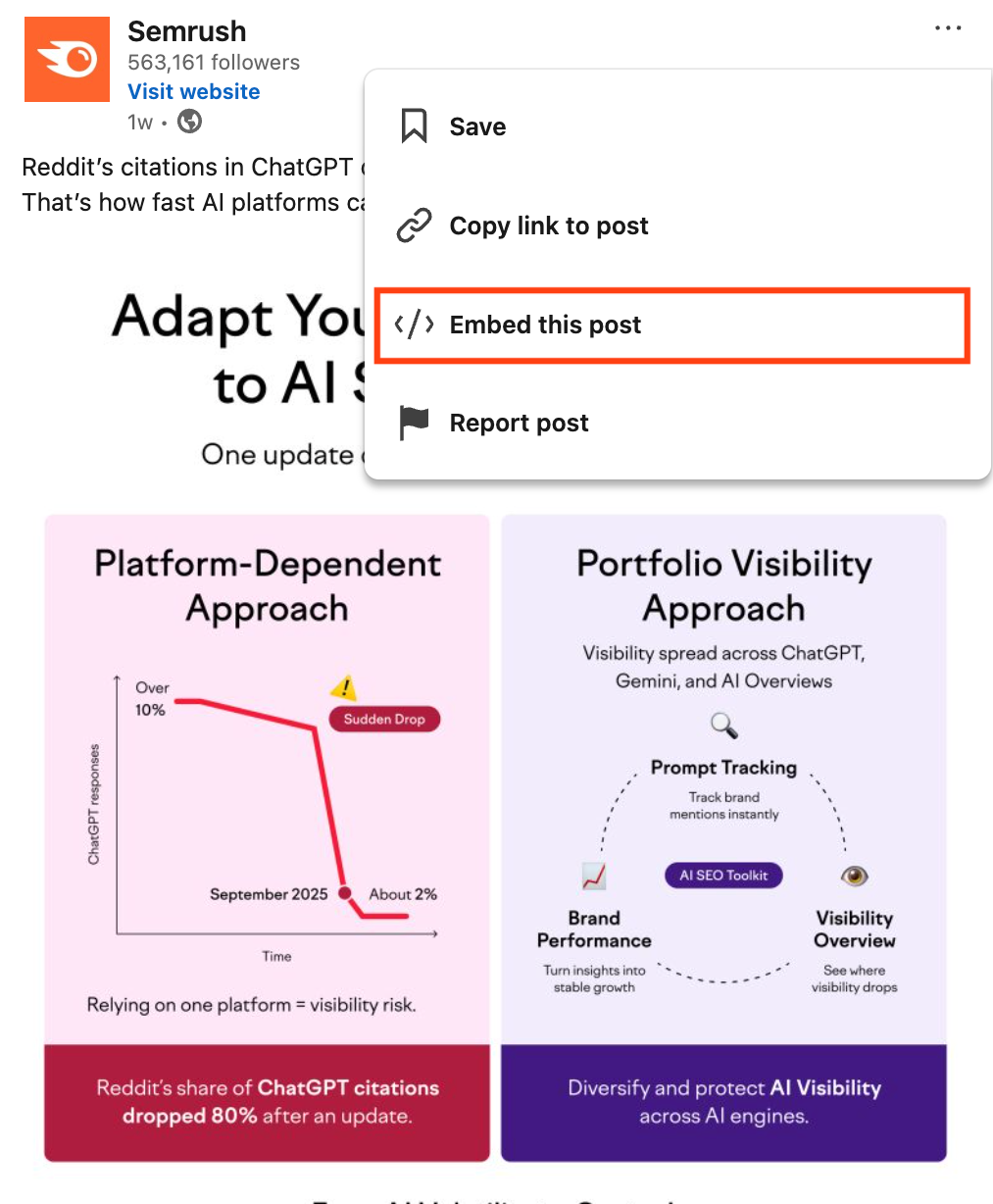
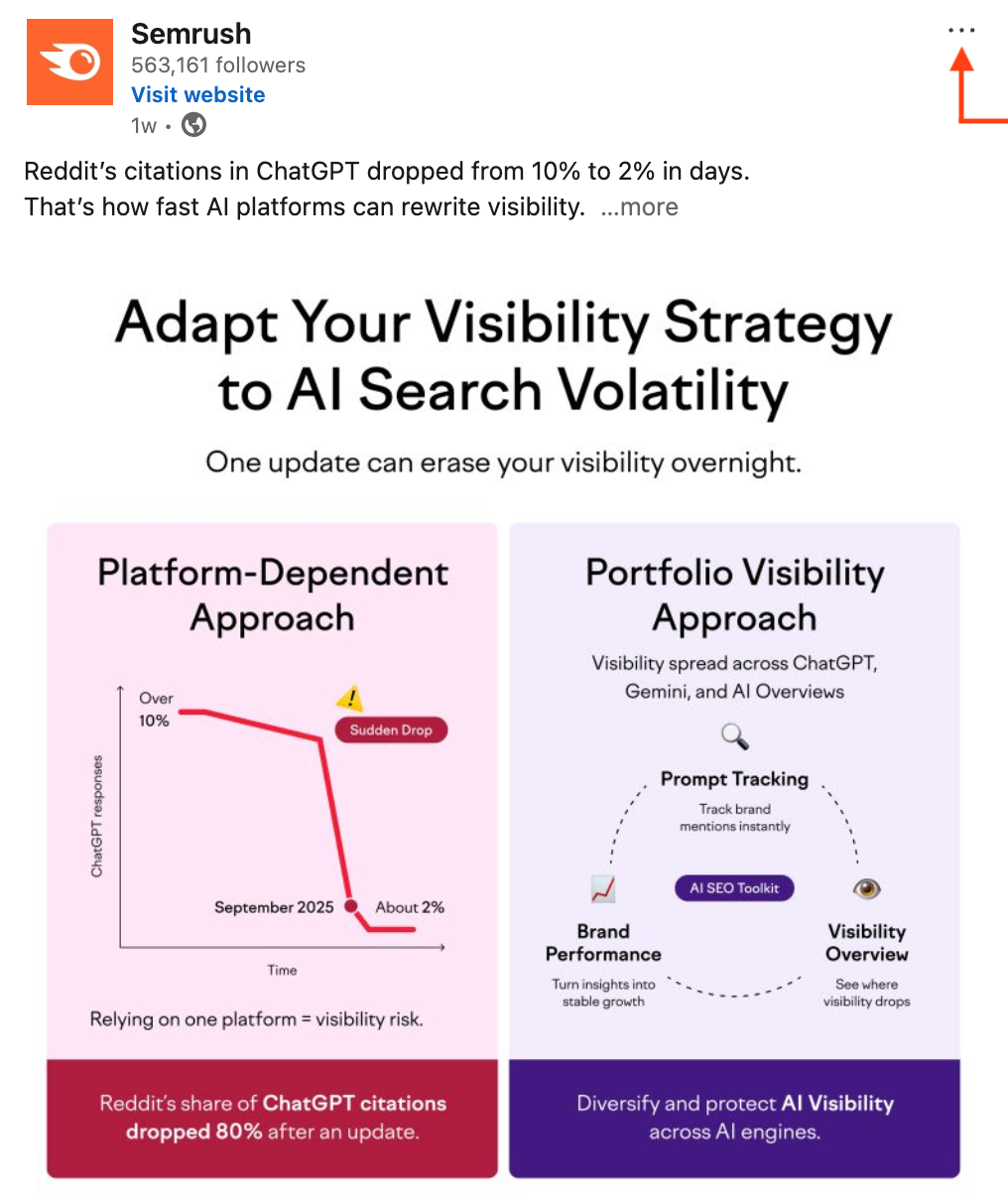
1. Go to any company or personal profile, which is publicly visible, and navigate to the post you want to embed. I’ll take Semrush for example.

Step 1 of embedding a LinkedIn post on a website natively

2. Click on the three-dot icon at the top right corner of the post.
Step 2 of embedding a LinkedIn post on a website natively

3. Click “Embed this post.”

Step 3 of embedding a LinkedIn post on a website natively

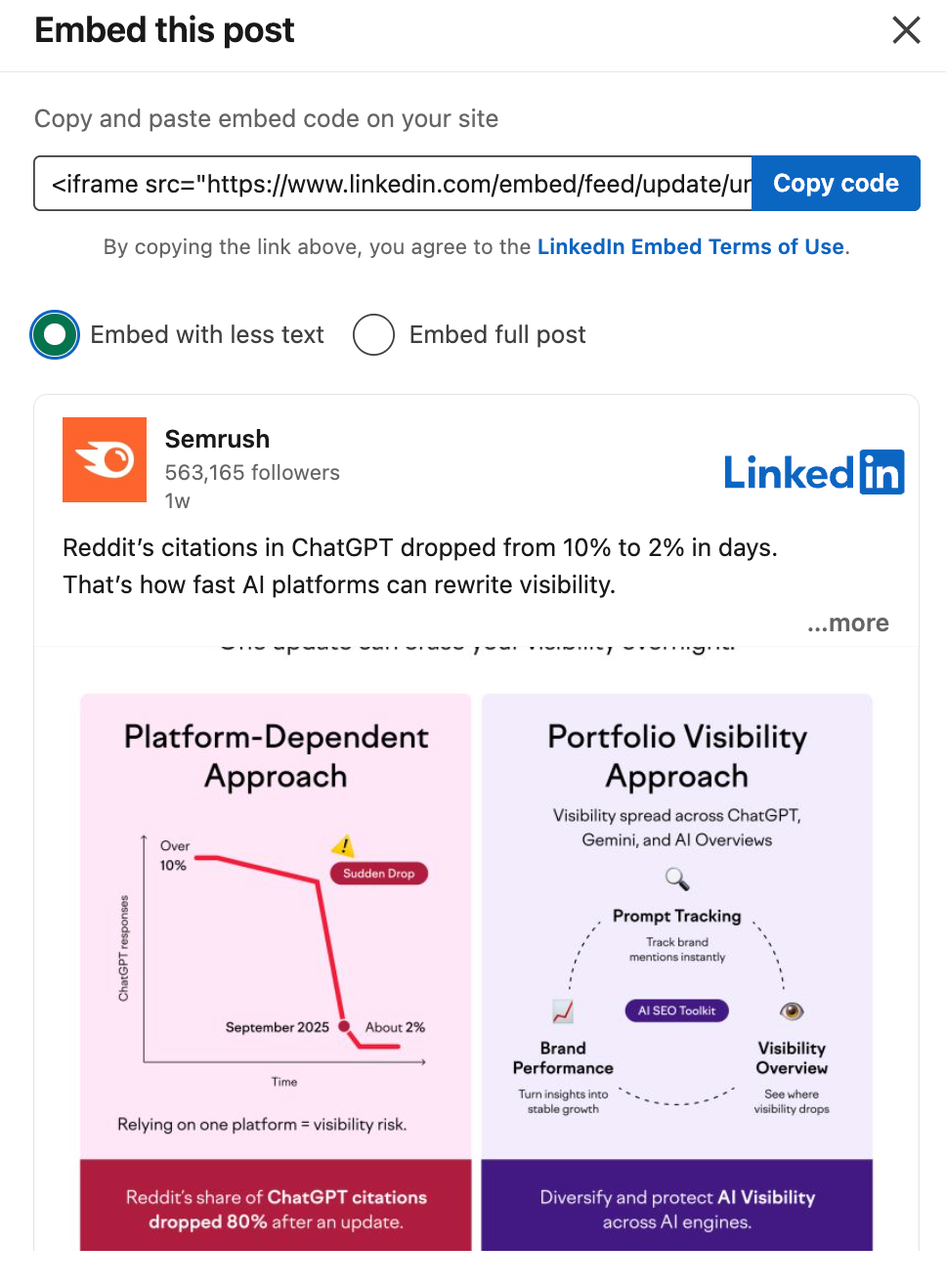
4. LinkedIn provides two embed codes: one displays a shortened version of the post, while the other embeds the full post. Copy your preferred code and simply paste it wherever you want to display LinkedIn posts on the web page. The same process will apply to video-based posts and articles.
Step 4 of embedding a LinkedIn post on a website natively

Although this is a simple process that anyone can follow, LinkedIn’s native embedding has some limitations:

  • You can only embed one post at a time: If you want to display an entire feed, you’ll need to manually repeat the embedding process for each post.
  • New posts are not updated automatically: Your embedded feed won’t refresh on its own – you must manually update it every time a new post is published.
  • Limited customization options: You can’t style the embedded feed or make it match your brand’s design.

Hence, it is not recommended to embed a LinkedIn feed natively. To display a dynamic LinkedIn feed that showcases multiple posts at once and allows for customization, you’ll need a dedicated social media aggregator tool like Juicer.io.

Method 2: Use a social media aggregator

social media aggregator is a tool that collects and displays content from multiple social media platforms in one place. These tools provide customization, automatic updates, and content moderation – features you don’t get with native embedding.

I’ll walk you through the process using Juicer.io, a platform trusted by over 200,000 users worldwide.

  1. Create a free account on Juicer.io and select LinkedIn as the social media source.
  1. Choose the type of LinkedIn source you want to embed: Company/School (requires a full page URL to embed LinkedIn company feed), Personal (requires a profile name to to embed LinkedIn profile feed), Hashtag (requires the hashtag only), or Group (requires Group URL).I’ve added Harvard University’s full page URL as an example.
  1. Click on the “Add source” button.
  1. You will be redirected to the Juicer.io dashboard with the LinkedIn feed displayed.
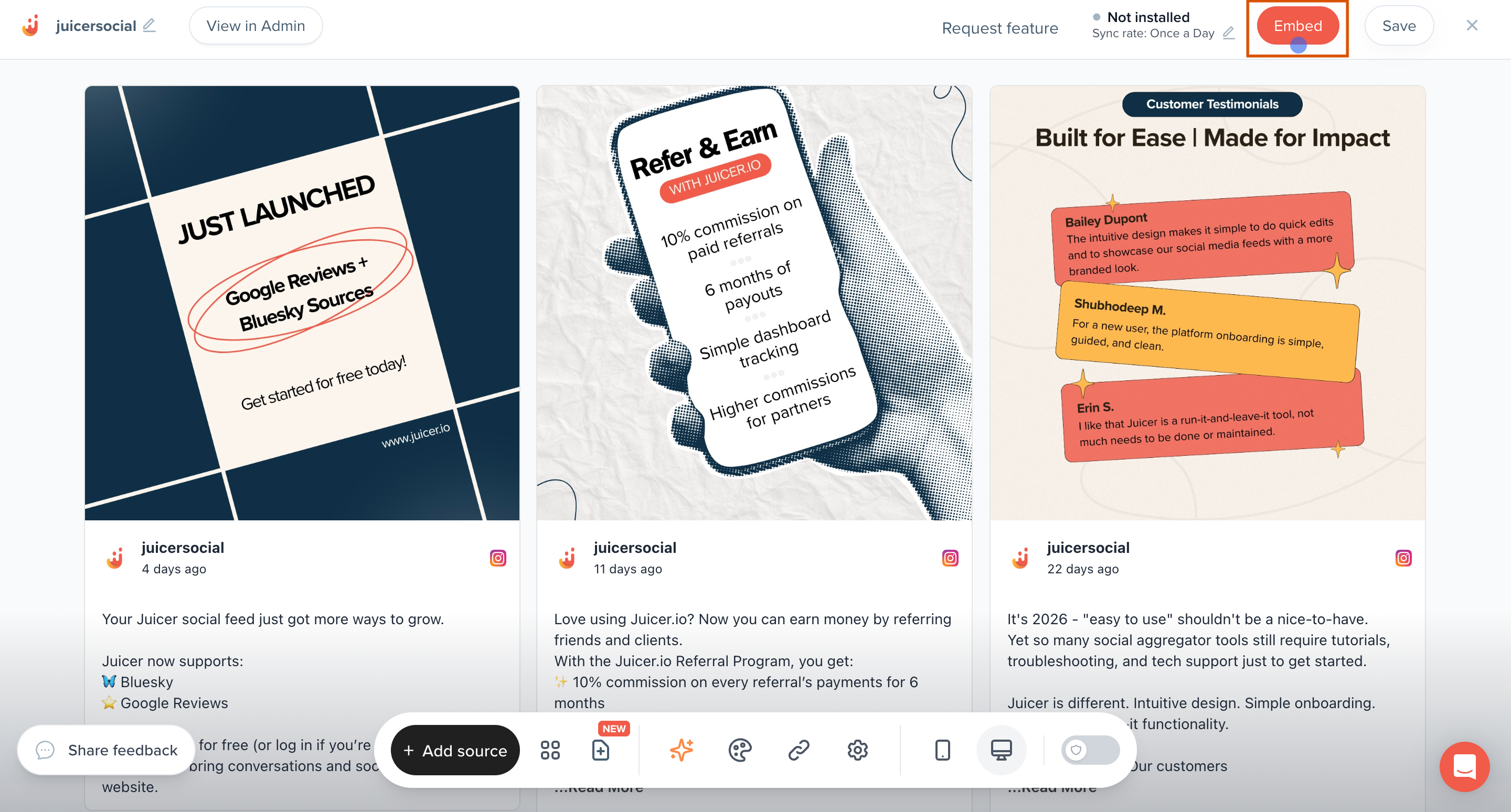
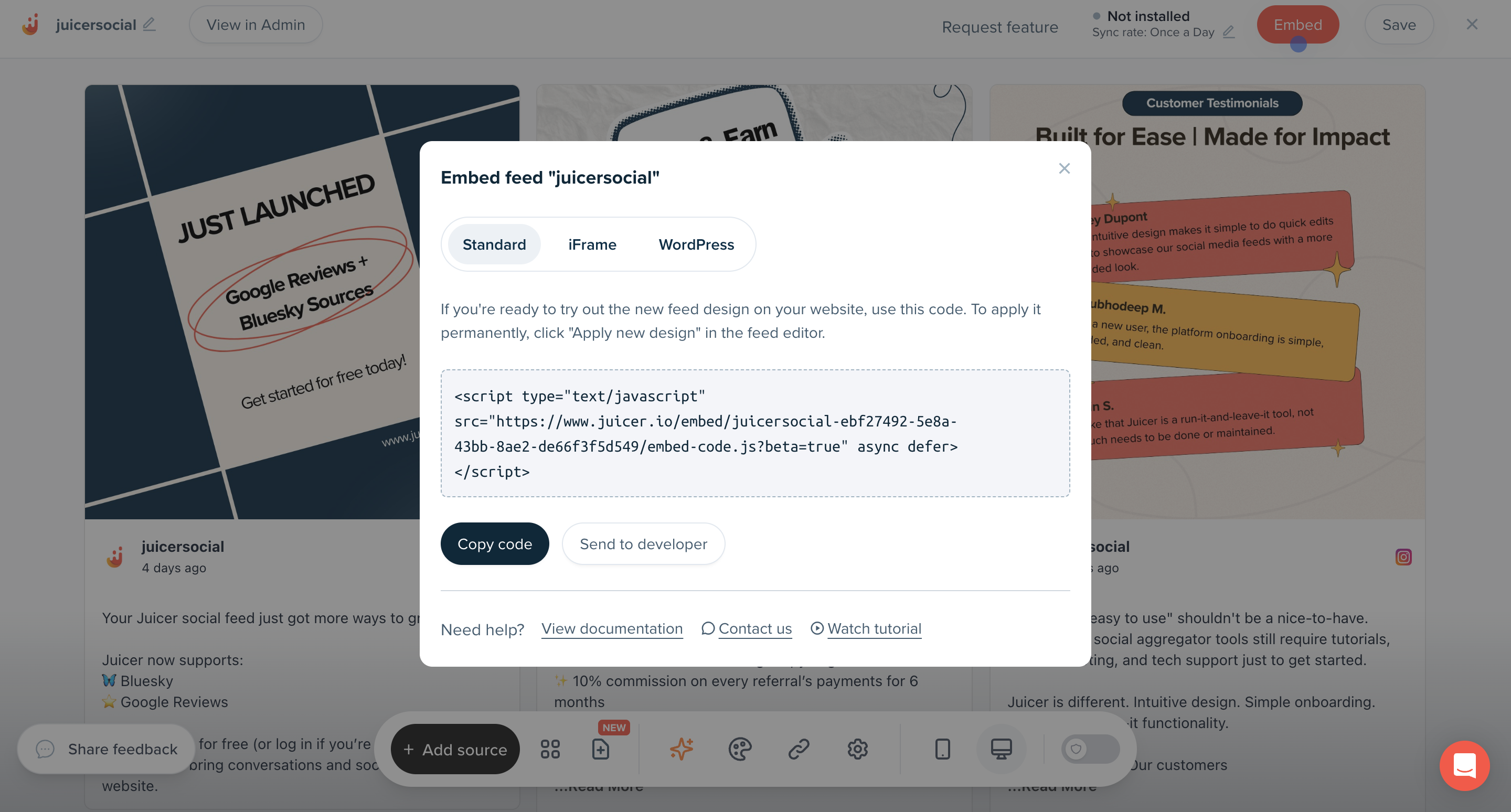
  1. Click the “Embed” button in the top right to get the code for displaying the feed into your website.
  1. Select your embed method from Standard, iFrame, or WordPress, depending on how you plan to add the feed to your website. Click on “Copy code” if you’re embedding the feed yourself or click on “Send to developer” if your team member will be taking over.
  1. Add the embed code to your chosen web page to successfully display the LinkedIn feed on your website.

Note: You can embed a LinkedIn feed with Juicer.io for free during your first week after signing up. After that, you need to upgrade to a paid plan (starting from $15/month) to continue using LinkedIn – learn more about pricing here.

Embed a LinkedIn Feed With Juicer.io In Minutes

Display your LinkedIn feed seamlessly with Juicer.io – no coding needed. Enjoy automatic syncing, full customization, and built-in moderation features.

Sign up for FREE

Which embed code to use for your website

For most websites, the Standard embed code is the one to use: it is a small snippet of code that drops into any HTML page, so it works on any site that lets you add code, whether that is a hand-built HTML page or a platform. Prefer to keep the feed sandboxed? Choose iFrame instead. If you’re on a specific website builder, the exact steps for pasting that code differ slightly by platform. We’ve written dedicated walkthroughs for the two most common ones: follow our guide to add a LinkedIn feed to WordPress or add a LinkedIn feed to Wix. Both use the same Juicer feed you just created.

Tips for making your embedded LinkedIn feed stand out

Adding your LinkedIn feed on your website is just the start, the below best practices will help it perform even better.

Tailor your LinkedIn feed to match your branding

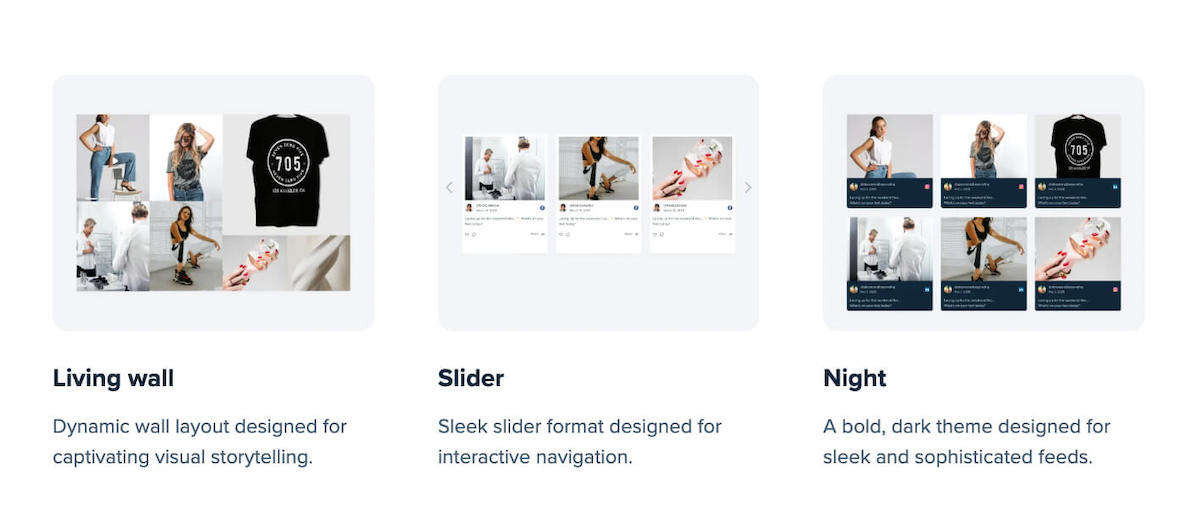
Your embedded LinkedIn feed should feel like a natural part of your website, not a disconnected element. With Juicer.io, you can choose from multiple layout options (as shown in the GIF below). You can also customize the font and color schemes to match your brand. For those who want more control, CSS customization allows for advanced styling.

Moderate which posts to show first

Not every LinkedIn post deserves a spot on your website. This is especially important when embedding hashtag feeds that pull in user-generated content, since you can’t control what people share under that hashtag.

Juicer.io’s moderation features help you create a curated LinkedIn feed by ensuring only brand-appropriate content makes it to your live social wall. You have two options:

  1. Manual moderation: Each post lands in a review queue where you choose what gets displayed.
  2. Automatic moderation: Posts are screened against your keyword list and automatically allowed or disallowed.
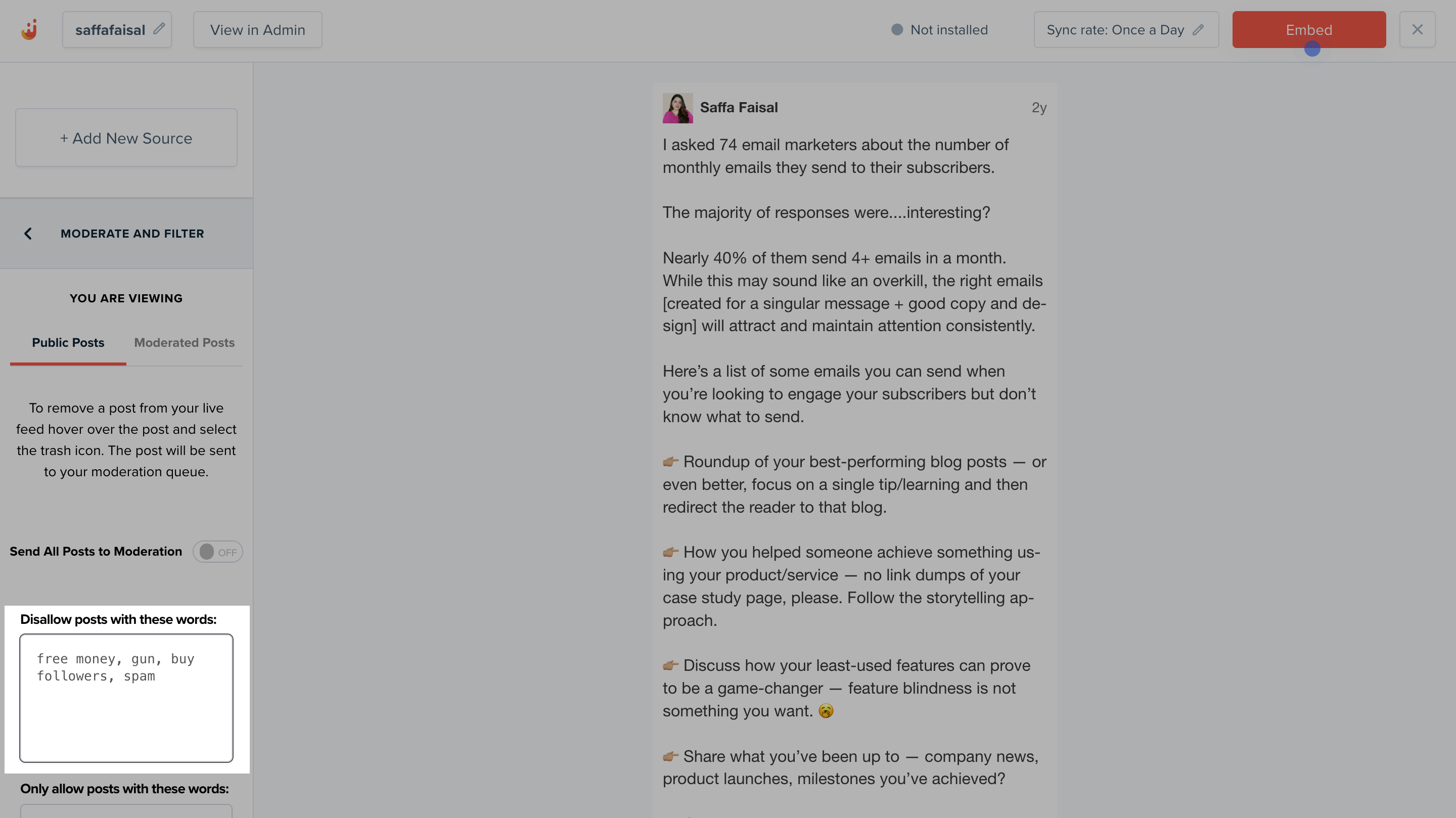
LinkedIn feed moderation in Juicerio

Test different placements of your LinkedIn feed

The placement of your LinkedIn feed can significantly impact its effectiveness. Try embedding it on your homepage for maximum visibility, in a dedicated social media section, or on an “About Us” page to humanize your brand. Test different locations and monitor engagement to discover where your feed resonates most with your audience.

See it in action: LinkedIn feeds on real websites

Below are real examples of how Juicer.io’s customers have successfully integrated LinkedIn feeds into their websites to showcase social proof, drive engagement, and strengthen their online presence.

Liverpool City Region Careers Hub

Liverpool City Region Careers Hub embedded their LinkedIn feed in a dedicated “Social” section on their website to share career opportunities, event announcements, and educational resources. This dynamic feed allows them to keep their audience engaged and updated without manually updating their website.

Liverpool City Regions LinkedIn feed embedded using Juicerio

Arelion

Arelion displayed their company’s LinkedIn feed on their website’s homepage. This approach showcases their latest achievements, press releases, and network expansions to visitors – building credibility and encouraging engagement with their brand on LinkedIn.
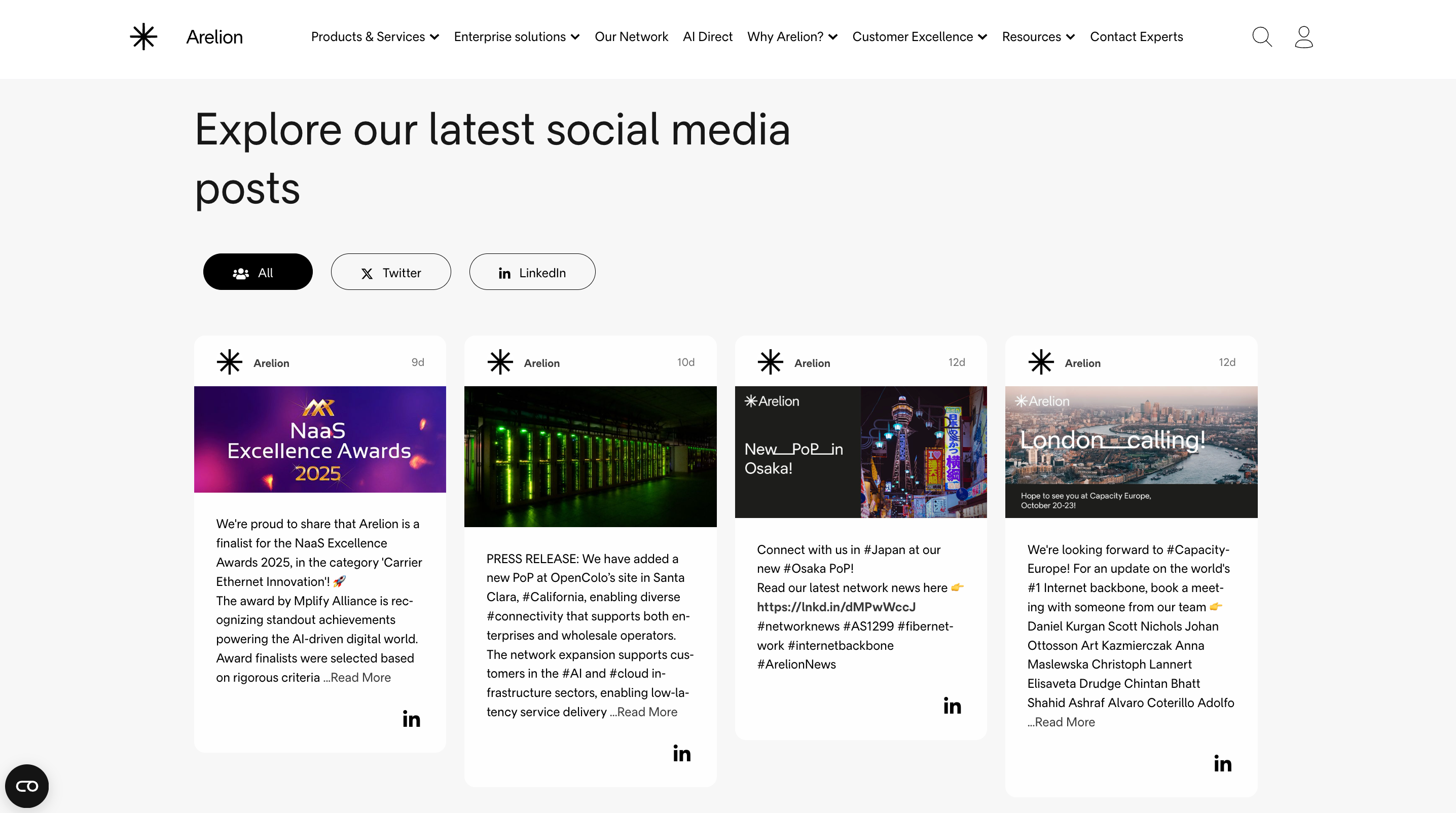
Arelions LinkedIn feed embedded using Juicerio

Campbell’s Foodservice

Campbell’s Foodservice integrated a LinkedIn feed into their homepage’s “Connect With Us” section to display real-time company updates and event content. By embedding their LinkedIn posts on their website, they keep their audience informed about company news and initiatives while creating a direct pathway for visitors to connect with them on LinkedIn.

Campbell foodservices LinkedIn feed embedded using Juicerio

Embed your LinkedIn social feed with Juicer.io

Displaying a dynamic LinkedIn feed on your website is one of the most effective ways to build trust, showcase social proof, and keep your audience engaged with fresh, real-time content. Whether you want to add your LinkedIn company feed or your personal LinkedIn account, an embedded feed can significantly boost visibility.

Juicer.io’s LinkedIn feed widget makes it simple. With just a few clicks, you can pull your LinkedIn feed content directly onto your website – no coding required. Create a free account and try it out for yourself.

FAQs about embedding LinkedIn feeds on websites

What is a LinkedIn feed?

A LinkedIn feed is the stream of posts, updates, and content you see on LinkedIn from your connections, followed pages, and groups.

Why should you embed a LinkedIn feed to your website?

Embedding a LinkedIn feed on your website helps showcase social proof, credibility, and real-time activity from your brand. It also keeps your website content fresh and encourages visitors to engage with you on LinkedIn.

What types of LinkedIn data can be added to a website?

You can embed different types of LinkedIn content on a website, including:
Company posts
Personal profile posts
Hashtag-based posts
LinkedIn articles or newsletters
Videos, images, and document posts

What does “embed this post” mean on LinkedIn?

On LinkedIn, the “Embed this post” option allows you to place a LinkedIn post on an external website or blog using an HTML code snippet. When you choose to embed a post, LinkedIn automatically generates an HTML code that you can copy and paste into your website to display the content directly. You can also embed LinkedIn posts in real-time using a LinkedIn aggregator like Juicer.io.

Is there an API for LinkedIn?

Yes, a LinkedIn API is available, but access can be limited and requires approval for specific functions. Alternatively, Juicer.io’s API service can seamlessly integrate your LinkedIn feed into your platform – simplifying the process. It allows you to pull LinkedIn updates efficiently and display them on your website without the hassle of managing the complexities of LinkedIn’s official API.

Why can’t I embed a LinkedIn post?

You usually can’t embed a LinkedIn post because the content isn’t public, LinkedIn doesn’t provide native embed code for all post types, or the platform’s API restrictions prevent direct embedding. In some cases, your website may also block external scripts or iframes due to security settings.
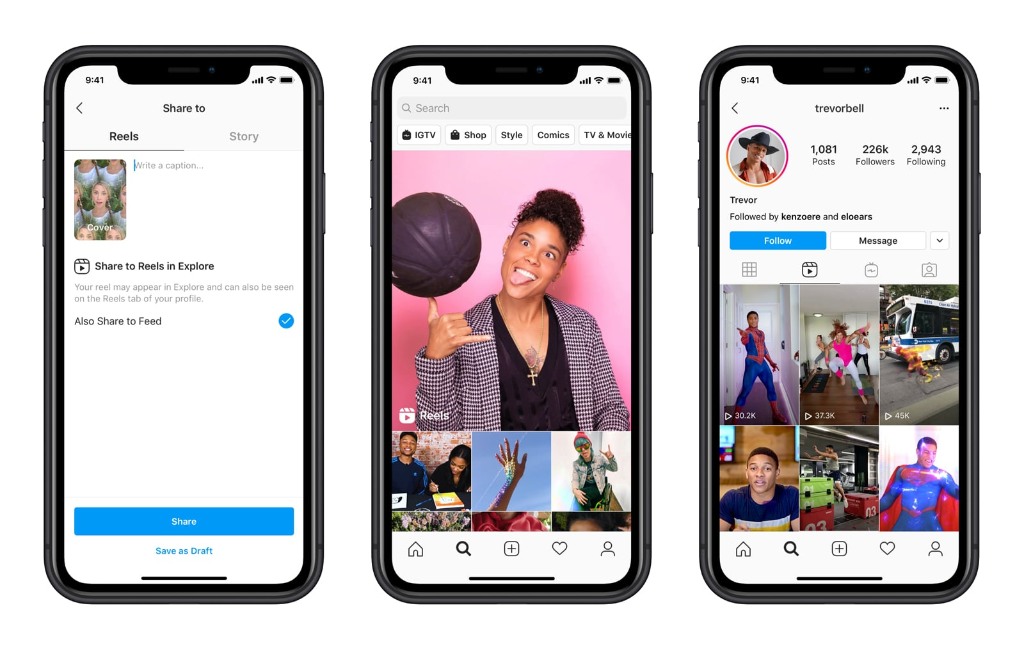
Embed Instagram Reels on Website

To embed a single Instagram Reel on your website, open Instagram in a desktop web browser, find the Reel, click the three dots (…) in the top right, choose “Embed”, copy the code, and paste it into your site’s HTML. That covers one Reel. To embed all your Instagram Reels as an auto-updating feed across any website, including Squarespace, WordPress, Wix, or a custom HTML site, use a free aggregator like Juicer instead.

Both methods work, and this guide walks through each one step by step. If you would rather display your whole profile instead of just Reels, see our companion guide on how to embed an Instagram feed.

Instagram Reels are short-form videos that sit on their own tab and can surface on the Explore page, so bringing them onto your own pages is a simple way to add fresh, dynamic content, show social proof, and keep visitors on your site longer. Here is how to get them embedded.

How to Embed a Single Instagram Reel Manually (The Official Way)

Instagram does include a native embed option, but it comes with real limits you should know before you start:

  • You can only embed one Reel at a time.
  • The embedded Reel does not update automatically when you post new content.
  • You cannot customize how the embedded Reel looks on your site.
  • The Reel must be on a public account. Instagram’s embed code is served through its oEmbed endpoint, which only returns content from public profiles, so a Reel on a private account will not embed.
  • The embed is tied to the original post. If you (or the original creator) later edit, archive, or delete that Reel, or switch the account to private, the embedded version breaks and shows nothing. A native embed is a live pointer, not a saved copy.

If you just want to drop one specific Reel onto a blog post, homepage, or landing page, the native method is fine and free. Here is how to embed an Instagram Reel one by one:

  1. Open Instagram in a desktop web browser and log into your account. (The Embed option is only available on the web, not in the mobile app.)
  2. Navigate to the Reel you want to embed.
  3. Click the three dots (…) in the top-right corner of the post.
  4. Select Embed from the menu that appears.
  5. Click Copy embed code.
  6. Paste the code into the HTML of any page where you want the Reel to appear.

That single video will now show on your site. If you want more than one Reel, an automatically updating wall, or a feed you can style to match your brand, the manual route gets tedious fast. That is where an aggregator comes in.

How to Embed All Your Instagram Reels Automatically (Auto-Updating Feed)

Embedding Reels one by one means re-doing the whole process every time you post. To display a living feed of your latest Reels that refreshes on its own, you can use Juicer to pull in your Reels and embed them as a single social wall.

This approach works on any website, whether it is plain HTML, PHP-based, or built with Squarespace, WordPress, Wix, Shopify, Weebly, or Joomla. Here is the full setup:

Step 1: Sign up for Juicer (it is quick and free)

Create a free Juicer account. It only takes a moment, and the free plan is enough to get a Reels feed live.

Step 2: Pick Instagram as your source

Right after signing up, you will see a list of social networks. Click Instagram to continue.

Select Instagram as a source in Juicer

Step 3: Connect your Instagram Reels

From the Instagram options, choose “Reels from a Username” and connect your account. This sets the source to Reels only (an only_reels filter that excludes regular photo and carousel posts), so the feed displays your latest Reels automatically rather than your whole grid. Unlike a native embed, this connects through your authenticated account, so it keeps working as you publish new Reels.

Select the Reels from a Username option in Juicer

A quick heads-up: Meta (which owns Instagram and Facebook) requires a Creator or Business account to connect Instagram this way. Juicer never stores your password or personal information during the connection.

Authenticate with your Creator or Business Instagram account

Step 4: Add your Reels to your social wall

Once you have authenticated, you will be returned to Juicer with your account name in the connection modal. Click Connect, and your Instagram Reels are added to your social wall. This is your auto-updating Instagram aggregator feed, the same hub experience you can manage from one dashboard.

Add your Instagram Reels source in Juicer

Step 5: Embed your Reels feed

Now display the feed on your site. Click Embed in Juicer and pick the output that fits your platform:

  • JavaScript (Default): the most popular option, works on almost any platform.
  • WordPress: a dedicated option for WordPress sites.
  • iFrame: handy for older platforms that do not support JavaScript.

Copy your code and add it to your site. The next sections show exactly where that code goes on the most common platforms.

Embed Your Reels Feed on Squarespace

Squarespace does not have a built-in Instagram Reels block, but its Code Block is built to hold custom embed snippets, which makes adding a Juicer Reels feed straightforward:

  1. While editing your Squarespace page, click an insert point and add a new Code Block where you want the feed to appear.
  2. Paste your Juicer JavaScript embed code into the Code Block. Leave the block’s display mode set to HTML (not Markdown) so the script runs instead of showing as text.
  3. Save and apply your changes.
  4. Preview the page to confirm the Reels feed displays correctly.

Because the feed is powered by Juicer, your Squarespace site stays in sync: new Reels appear automatically without you re-editing the page.

Embed Your Reels Feed on WordPress

To add a Reels feed to a WordPress site, you have two easy options:

  • Install the free Juicer WordPress plugin from the official plugin repository, then copy the shortcode shown in your dashboard into any page or post. You can also use the Juicer PHP function if you prefer.
  • Or use the WordPress embed output from Step 5 and paste it directly into a block.

Either way, your WordPress site shows a live Reels wall that updates as you publish.

Embed Your Reels Feed on Wix, Shopify, or a Custom HTML Site

The same JavaScript embed code works everywhere else, you just drop it into each platform’s HTML-embed element:

  • Wix: in the Wix Editor, click the + to add an element, choose Embed then Embed HTML, and paste your Juicer code into the HTML box. Resize and position the element, then publish.
  • Shopify: add your code through a Custom HTML section in the theme editor (no code editing needed), or, for full control, go to Online Store > Themes > Edit code and paste it into the section or template where you want the feed.
  • Custom HTML site: paste the Juicer code directly into your page’s HTML wherever you want the Reels feed to render.

Juicer also publishes platform-specific setup guides for major site builders, so you have a reference for whichever platform you use.

Manual vs Automatic: Which Method Should You Use?

Both methods are valid. The right one depends on how many Reels you want to show and whether you want the feed to maintain itself.

Method Best for Keeps itself updated? Customizable? Reels-only curation
Native Instagram embed A single, specific Reel on one page No, it is a fixed snapshot that breaks if the Reel is edited or deleted No One Reel, hand-picked
Juicer auto-feed (JavaScript) A wall of your latest Reels on any platform Yes, pulls new Reels automatically Yes, layout and CSS Yes, the “Reels from a Username” source filters out regular posts, and you can moderate by keyword or hashtag without code
Juicer WordPress plugin WordPress sites that want a shortcode Yes Yes Same Reels-only source as the JavaScript feed

If you only need one hero Reel on a landing page, the native embed is the fastest path. If you want an ongoing, on-brand Reels wall that you set up once and forget, the automatic feed saves you the repeat work.

Why Embed Instagram Reels on Your Website?

Short-form video is the format people lean into, so putting your Reels on your own pages is a fast way to make a site feel alive to every visitor, not just your Instagram followers. What embedding Reels specifically buys you:

  • Video social proof. A wall of real Reels is a strong form of user-generated content (UGC): products in use, behind-the-scenes clips, and customer moments are more convincing than static images for someone deciding whether to trust you.
  • Movement on the page. Auto-playing short clips give visitors something to watch the moment they land, which can hold attention longer than text alone.
  • A reason to follow. Visitors who enjoy your Reels on-site often tap through to your Instagram profile, turning site traffic into followers.

Embedding Instagram Reels might sound technical, but as you have seen, it comes down to either one native embed for a single Reel or a one-time Juicer setup for an auto-updating Reels wall. If you also post short-form video elsewhere, you can embed it the same way: see our guide on how to embed a TikTok video feed.

Try Juicer free and get your Instagram Reels feed live today.

How to Embed TikTok Feed on Website: A Complete Guide for All Users

 Want to get a TikTok feed on your site? You’re not alone. With more than 1 billion monthly active users, TikTok is today among the most powerful social media sites worldwide. Its quick rise presents businesses and creators with a unique chance to interact with users through interesting, bite-sized video content.

With TikTok feeds embedded on your website, static pages can become dynamic hubs of interesting content. Whether you are a brand wanting to display user-generated content, an influencer wanting to highlight your newest videos, or a company wanting to boost social evidence, embedding TikTok content provides a cross-platform experience to your users without fragmentation.

Who Should Embed TikTok Feeds?

This guide is specifically designed to help:

  • Small Business Owners: Demonstrate products in use, incorporate customer testimonials, and create a community without needing a lot of technical expertise

  • Website Owners: Boost engagement and time on page with automatic dynamic content

  • Digital Marketers: Develop cross-platform integrated marketing campaigns and reinterpret successful TikTok content

  • Content Creators: Centralize your content portfolio and provide easy access to your latest work

  • Social Media Managers: Streamline content management and improve campaign performance tracking

  • Web Developers: Employ clean, efficient solutions while maintaining the site in operation

To provide you with a step-by-step guide, here are some of the methods through which you can add TikTok feeds on your website, ranging from the official TikTok embedding method to advanced social media aggregators like Juicer that simplify the task for you. Here’s how:

  • Embed individual TikTok videos using the official method

  • Create a complete TikTok feed display with several videos at once

  • Customize your TikTok feed to match your website’s design

  • Implement platform-specific solutions for WordPress, Shopify, and more

  • Optimize your embedded feed for your specific target audience

Let’s dive in and transform your site with the magic of TikTok content.

What is a TikTok Feed & Why Should You Embed It on Your Website?

A TikTok feed is a collection of TikTok videos that are shown in a scrollable window, much like you would see if you were inside the TikTok application itself. When you embed content from TikTok on your website, it’s a live element of your website that gets updated every time there’s new content to be had, so your website is live and current at all times.

Advantages of Embedding a TikTok Feed on Your Website

1. Increased Engagement and Time on Site
TikTok’s entertaining and brief videos grab attention like few other things. Incorporating these interesting videos onto your website can greatly increase the time spent there and decrease the number of individuals who leave in a hurry. Recent research has shown that websites with social media streams have session lengths that are 20-30% longer.

2. Fresh, Dynamic Content Without Extra Work
Once your TikTok feed is embedded, it will automatically update whenever you add new content so your website is always up to date without having to be manually updated. This “set it and forget it” feature is a time saver that keeps content updated.

3. Social Proof and Brand Credibility
Showing your TikTok presence on your site shows social proof, illustrating to visitors that your brand is active and current on multiple sites. For companies marketing to younger demographics, such presence is more and more coveted and appreciated.

4. Cross-Platform Promotion
A consolidated TikTok feed turns your website and social media into a two-way street. Your website visitors learn about your TikTok content and can follow you, and TikTok audiences can click through to your website in greater detail.

5. Prioritize User-Generated Content
For brands, embedding TikTok live streams of user-generated content provides real social verification and rewards your community. It is especially useful for e-commerce businesses that would want to showcase products being used in real environments.

6. Target Younger Demographics
Since 60% of TikTok users are Gen Z, capitalizing on the content of TikTok portrays your business as a business that is listening to younger generations. This is important for companies that are interested in reaching new consumer bases.

Targeting Your Audience with TikTok Feeds

Knowing your audience is important when you are adding TikTok content. Different users have different requirements:

  • Small Business Owners: ROI and community focus with genuine, straightforward content

  • E-commerce Websites: Highlight product demonstrations, reviews from users, and user-generated content

  • B2B Companies: Highlight thought leadership and educational content that establishes expertise

  • Media Organizations: Feature trending topics and cultural moments to increase relevance

  • Educational Institutions: Connect with prospective students through content about campus life

By customizing your TikTok feed strategy to your particular audience and business objectives, you can get maximum engagement and conversion potential.

How to Embed Single TikTok Videos: The Official Method

The easiest method of adding TikTok videos is via TikTok’s official embed option. It is great when you need to insert a single video in a blog article, product page, or any other unique section of your site. Here is how:

Step-by-Step Guide to Embedding Individual TikTok Videos

Step 1: Go to TikTok.com or open the TikTok app and find the video you desire to embed.

Step 2: On the right-hand side of the video, click on the “Share” button (the arrow symbol)

Step 3: Click “Embed” beneath the sharing options displayed

Step 4: You’ll see a pop-up with the embed code. You can copy it to your clipboard by clicking on “Copy Code”

Step 5: Go to your website content management system and paste the code where you want to add the TikTok video

That’s it! The TikTok video will now be shown on your website, along with all the interactive features such as the like button, creator’s name, and caption.

Limitations of the Official Embedding Method

While the official method is straightforward, it does have several limitations to be aware of:

  • One Video at a Time: You can only embed videos individually, making it tedious to create a multi-video feed

  • Limited Customization: The embedded videos maintain TikTok’s standard look and feel with minimal styling options

  • Manual Updates Required: Each time you want to add a new video, you’ll need to manually get the embed code and update your website

  • No Content Curation: You can’t easily filter content based on hashtags or other criteria

  • Platform-Specific Issues: Certain website platforms can do more to enable TikTok embeds to function correctly

For these reasons, most businesses and content owners opt to use dedicated social media aggregators such as Juicer to generate more robust, customizable TikTok feeds for their sites.

How to Embed TikTok Feeds with Juicer

If you’d prefer to display a feed of TikTok videos as a customizable, auto-updating feed, Juicer’s TikTok feed aggregator is a great way to go. This method is simple, flexible, and customizable in design.

Why Choose Juicer for Your TikTok Feed?

Juicer solves all the limitations of the official TikTok embedding method by offering:

  • Multiple Videos in One Feed: Display your entire TikTok content in a single, scrollable feed

  • Automatic Updates: New TikTok videos appear in your website feed without manual intervention

  • Customizable Design: Match your feed’s appearance to your website’s branding

  • Content Curation: Filter which videos appear based on hashtags, keywords, or manual approval, select TikTok content you want to pin

  • Analytics: Learn more about how people engage with your TikTok videos

  • Multi-Platform Integration: Combine TikTok and other social media sources into a single screen

Why Choose Juicer for Your TikTok Feed?

For digital marketers and social media managers, these tools provide the ability to use coordinated cross-platform content management and strategy more efficiently.

Step-by-Step Guide to Embedding TikTok Feeds with Juicer

Follow these easy steps to make your website possess a dynamic TikTok feed:

Step 1: Create a Juicer Account
Sign up for a free Juicer account to get started. With the free plan, you can link your TikTok feed and refresh it every 24 hours.

Step 2: Connect Your TikTok Account
After logging in, click on the “Add Social Media Source” and select TikTok from the sites. You also have the option to change colors, fonts, and other images to match your website theme.

Step 3: Customize Your Feed’s Appearance
Juicer offers multiple display options for your TikTok feed. You can choose from layouts like:

  • Grid (organized tiles)

  • Slider (horizontal scrolling)

  • Small Feed (compact view)

You may also personalize colors, fonts, and other graphics to match the theme of your website.

embed tiktok feed on website

Step 4: Set Up Content Filtering (Optional)
If you want to curate which TikTok videos appear in your feed, Juicer offers several filtering options:

  • Filter by hashtags to only show specific content

  • Set up moderation to manually approve videos before they appear

  • Create filters to automatically include or exclude videos containing certain keywords

Step 5: Get Your Embed Code
After setting up your feed, click “Embed” on the left sidebar menu. Juicer provides several embedding options, including:

  • JavaScript embed (recommended for most websites)

  • WordPress shortcode (for WordPress websites)

  • PHP function (for advanced customization)

Step 6: Paste the Code on Your Website
Copy the embed code and insert it into the area of your website where you want the TikTok feed to be displayed. The exact process varies depending on your website platform:

Platform-Specific Instructions for Embedding TikTok Feeds

WordPress

For WordPress websites, Juicer offers a dedicated plugin that makes integration even easier:

  1. Install and activate the Juicer WordPress Plugin

  2. Copy your Juicer feed name from your Juicer dashboard

  3. Add the shortcode [juicer name=”your-feed-name”] to any page or post where you want the feed to appear

  4. For theme integration, you can use the PHP function in your template files

Juicer WordPress Plugin

WordPress is the most popular content management system for businesses of all sizes, from small business owners to enterprise companies.

Shopify

To add your TikTok feed to Shopify:

  1. From your Shopify admin, go to “Online Store” > “Themes”

  2. Click “Actions” > “Edit code”

  3. Find the template file where you want to add the feed (e.g., home page, product page)

  4. Paste your Juicer JavaScript embed code

  5. Save the changes

Shopify is the ideal e-commerce platform for small business owners and digital entrepreneurs looking to showcase products through TikTok content.

Wix

For Wix websites:

  1. Edit your Wix site and click the “+” button to add elements

  2. Select “Embed” > “Embed HTML”

  3. Paste your Juicer JavaScript code into the HTML box

  4. Click “Update” and position the element where you want it to appear

Wix’s drag-and-drop website builder makes it particularly accessible for small business owners with limited technical experience who want to enhance their online presence with social media content.

Squarespace

To add your TikTok feed to Squarespace:

  1. Edit the page where you want to add your feed

  2. Add a “Code” block

  3. Paste your Juicer JavaScript embed code

  4. Save your changes

Squarespace is well-liked by content creators and creative professionals who focus on good design.

Custom Websites

For custom-coded websites, just paste the JavaScript embed code into the HTML where you want the feed to show up. For more control, developers can use the Juicer API to set up custom configurations.

Web developers working on custom solutions can integrate TikTok feeds more seamlessly by using Juicer’s API documentation and implementing custom CSS for perfect brand alignment.

Best Practices for TikTok Feed Embedding

To get the most from your embedded TikTok feed, follow these best practices:

Design Integration

  • Match Your Brand Aesthetic: Refresh the colors and appearance of your feed to suit your site’s design.

  • Consider Placement Carefully: Position your TikTok feed in a place where it complements, not takes away from, useful content like product details or calls-to-action.

  • Optimize for Mobile: Your embedded feed should look good on mobile since the majority of TikTok users utilize their phones for the app.

Content Strategy

  • Curate Thoughtfully: Not every TikTok video may be appropriate for your website audience; use filters to showcase your best content. Also, you can pin your favorite TikTok video to the top of the feed.

  • Update Regularly: Ensure your TikTok account is active so new content is posted in your embedded feed

  • Mix Different Types of Content: Use different types of content on TikTok, like informative and entertaining, to attract visitors

  • Align with User Base: Create content that is relevant to the target age, interests, and concerns of those you are trying to reach

  • Consider User Journey: Place different types of TikTok content at appropriate stages of the customer journey

Technical Considerations

  • Monitor Loading Speed: Embedded feeds can impact page load times; if speed becomes an issue, consider limiting the number of initial videos displayed

  • Test Across Browsers: Verify your TikTok feed works properly across different browsers and devices

  • Implement Lazy Loading: Configure your feed to load videos only when users scroll to them, improving initial page load performance

  • Ensure Responsiveness: Verify that your embedded feed adjusts appropriately across device sizes for optimal user experience

Frequently Asked Questions

Can I embed multiple TikTok videos at once?

Through TikTok’s official embedding technique, it is possible to embed only one video at a time. However, using a social media platform like Juicer, it is possible to showcase many videos in a single feed that auto-updates itself.

Does TikTok have an official widget for websites?

TikTok offers an embed code for individual videos, but it does not provide an official tool to embed multiple videos or feeds. That’s why tools from other companies, like Juicer, play a very important role in generating complete TikTok feeds on websites.

How do I embed a TikTok feed on WordPress?

The easiest way is to use Juicer’s WordPress plugin. First, install the plugin. Then, connect your TikTok account through Juicer. Finally, use the shortcode provided to showcase your feed anywhere on your WordPress site.

Will embedded TikTok videos affect my website’s loading speed?

Embedded videos impact load time, but Juicer’s integration includes options like lazy loading that minimize the effect. You can also limit the number of videos displayed initially to improve performance.

Can I moderate which TikTok videos appear in my embedded feed?

Yes, in Juicer, you can activate moderation to screen videos and approve them prior to their appearance in your feed. You can also establish filters dependent on hashtags or keywords to include or exclude content manually.

How do I customize the look of my TikTok feed?

Juicer lets you customize a lot, so you can change colors, layouts, post size, and more to fit your website’s design. If you want to customize even more, you can use custom CSS.

For developers on the web, this provides the potential for consistency of brand across platforms without sacrificing performance.

Can you embed TikTok feeds on Shopify, Wix, or Squarespace?

Yes, Juicer works with all the big website platforms. Just copy your JavaScript embed code from Juicer and add it to your site using the appropriate embed or HTML block on your platform. Website builders like Wix, Squarespace, and Shopify make it easy for users without technical experience to integrate dynamic TikTok content.

Take Your Website to the Next Level with Embedded TikTok Feeds

Interactive content is necessary in order to attract people to your website. Not only are you showing videos through embedding a TikTok feed on your website, but you’re also making it an engaging experience that retains your audience on your brand across platforms.

If you’re a small business owner and wish to feature genuine content, if you’re a social media manager and planning your content strategy, or if you create websites and wish to develop solid solutions, embedding TikTok video feeds into your website strategy can actually boost engagement, provide social proof, and make your site look fresh and updated. Are you prepared to revolutionize your website with TikTok content?

Ready to transform your website with embedded TikTok content? Sign up for Juicer free today and start creating your custom TikTok feed in minutes. No credit card required, and you can be up and running with a professional-looking social feed before your next TikTok video finishes uploading.

How to Embed Instagram Feed on Any Website for Free (Easy Guide)

Adding an Instagram feed on your website lets you display your latest posts, keep your website fresh, and connect your social media with your brand.

In this guide, I’ll show you exactly how to embed an Instagram feed on any website – both using Instagram’s native embed option and with a third-party tool that gives you more control and customization.

To embed an Instagram feed on your website, you have two routes. For a single post, open it on Instagram in a desktop browser, click the three-dot menu, choose “Embed,” and paste the HTML code into your page. For a free feed that refreshes itself whenever you post, connect your Instagram account to a social media aggregator like Juicer and paste its embed code.

How to embed an Instagram post using the official way

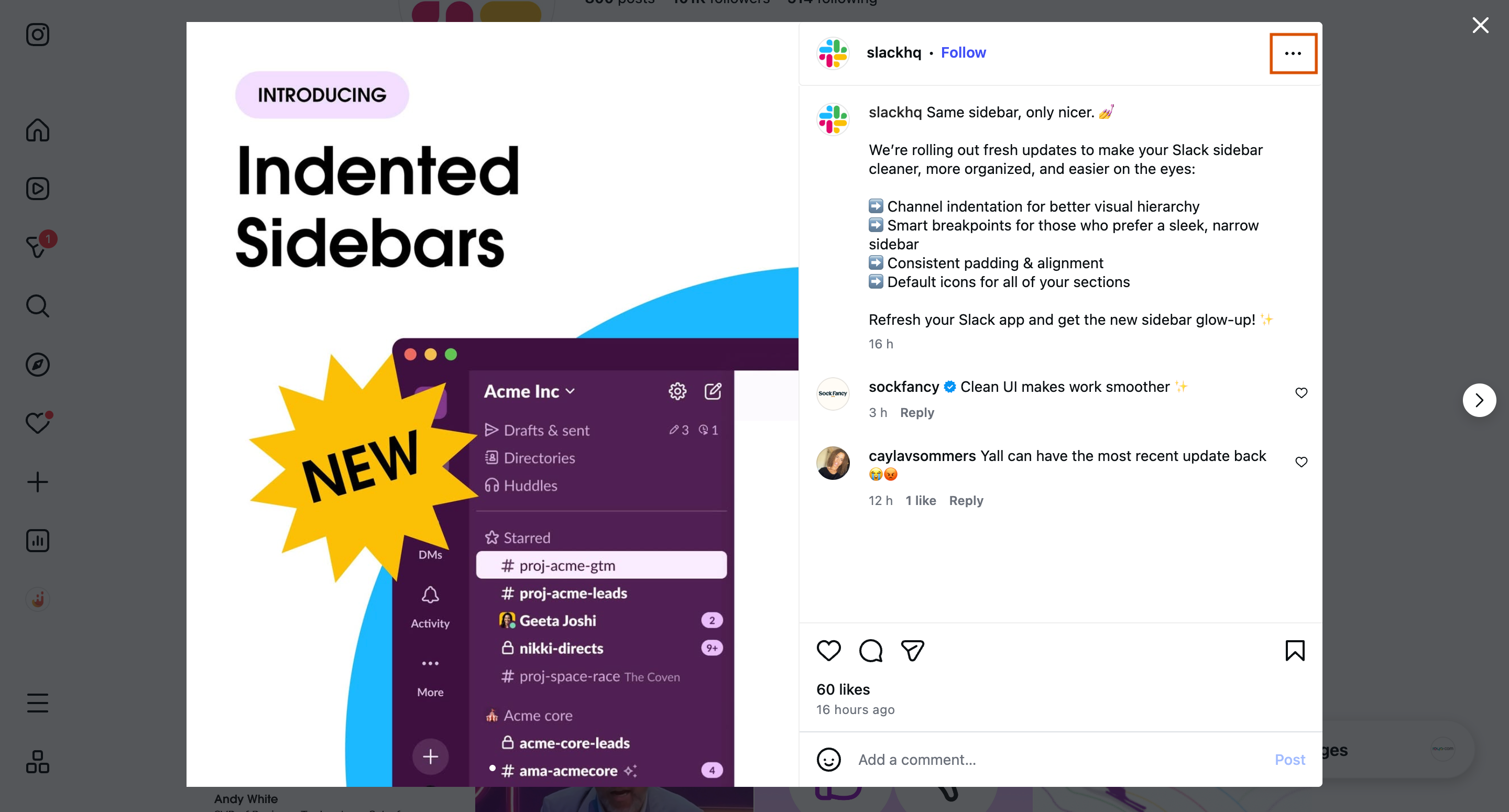
  1. Go to the specific Instagram post or reel you want to embed. To get the embed code, open Instagram in a desktop or mobile browser – it won’t work on the Instagram app.

    I’ll be taking Slack’s Instagram profile as an example.
  2. In the top-right corner of the post, click the three-dot menu.
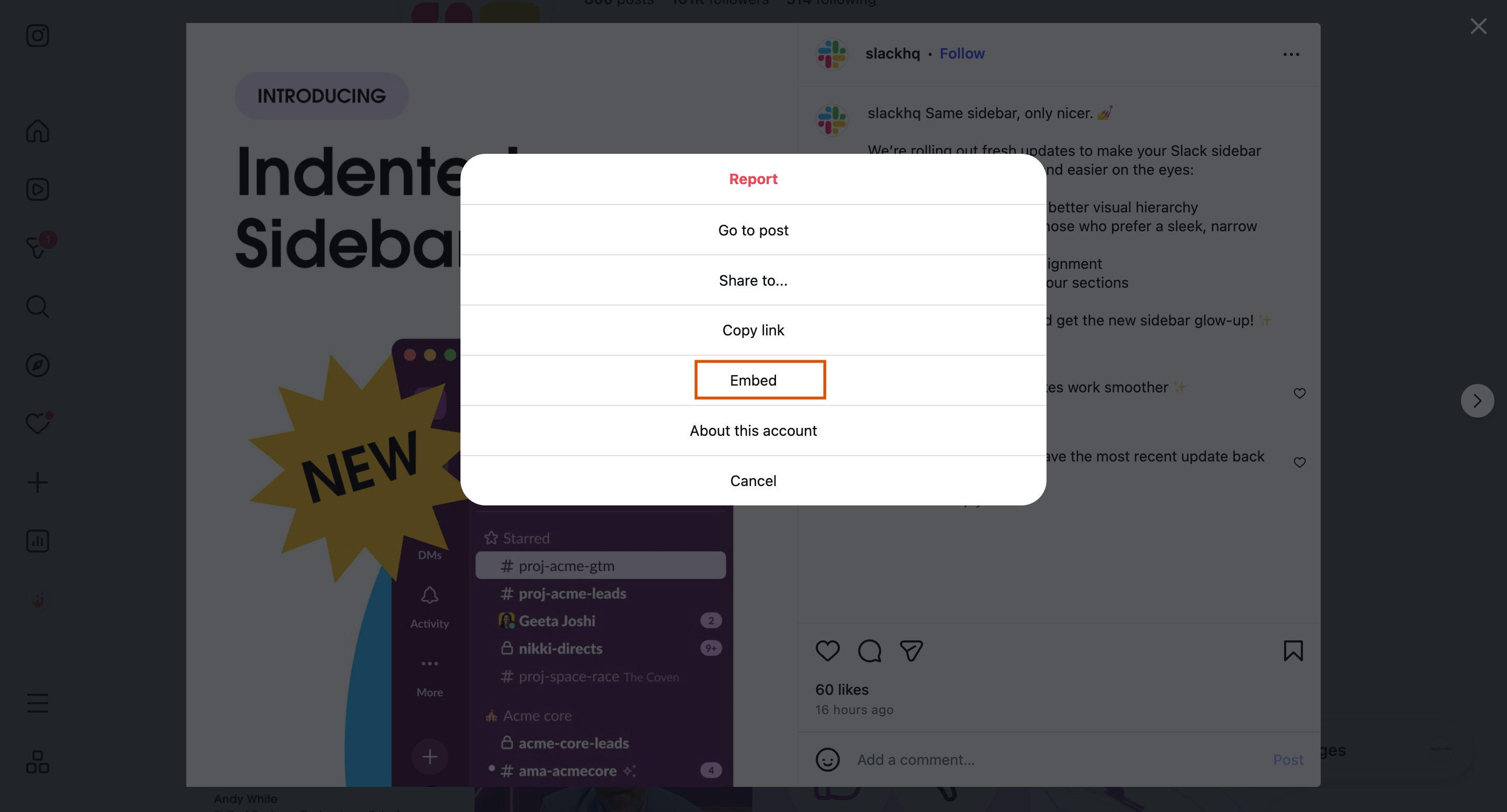
  1. From the dropdown menu, click “Embed.”
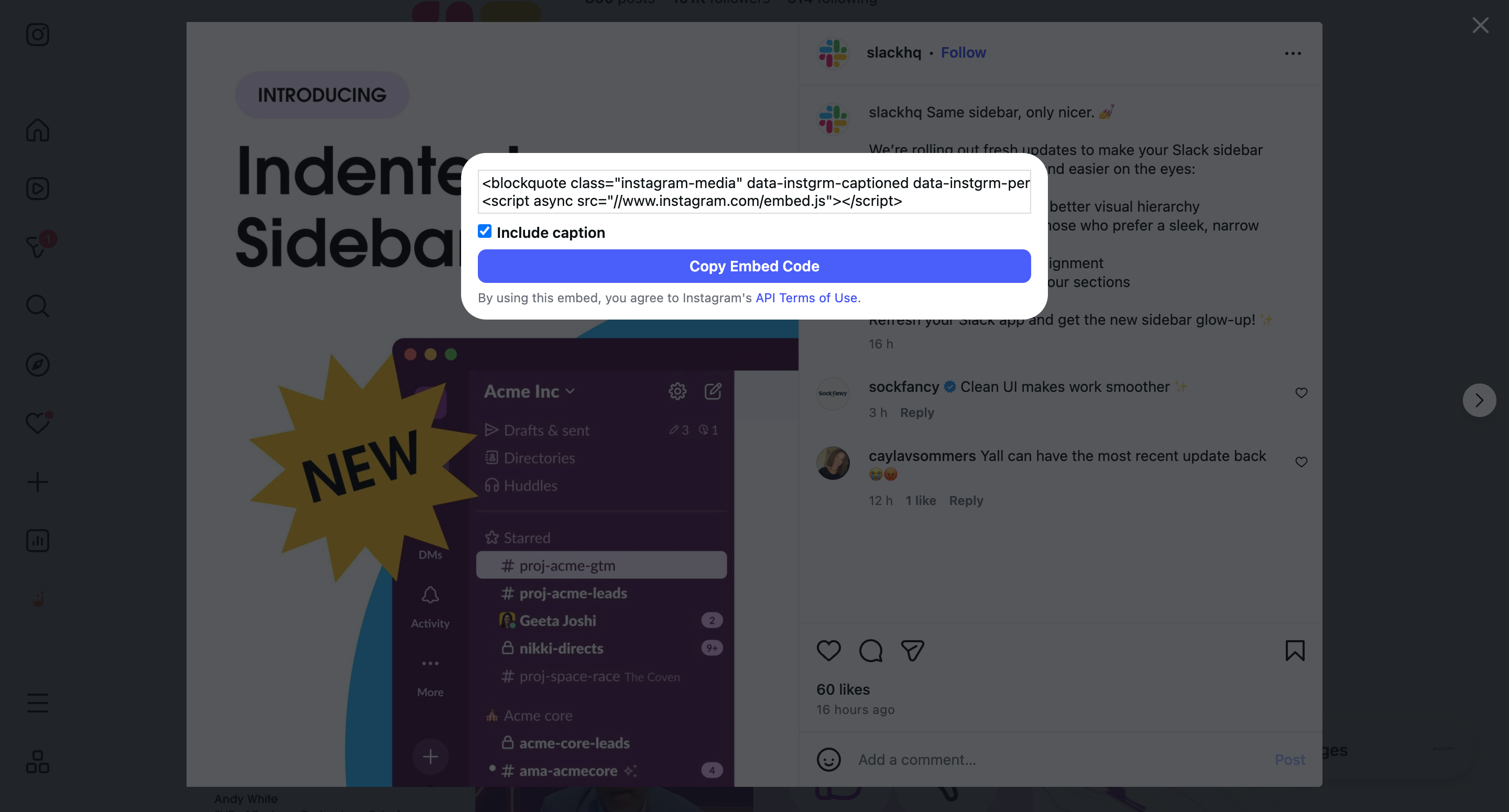
  1. Copy the embed code from the popup that will appear. From here, paste the HTML code into your website’s HTML editor, code block, or embed element – wherever you want the Instagram post to appear.

The HTML code Instagram gives you is a <blockquote class="instagram-media"> element followed by Instagram’s embed script. Instagram fills the block with the post ID and a longer fallback preview, but the two lines that actually render the post are the blockquote and the script tag:

<blockquote class="instagram-media"
data-instgrm-permalink="https://www.instagram.com/p/POST_ID/"
data-instgrm-version="14">
</blockquote>
<script async src="//www.instagram.com/embed.js"></script>

Replace POST_ID with the code from the post’s URL (Instagram does this for you when you copy from the “Embed” popup), then paste both lines into your page’s HTML wherever you want the post to appear. The embed.js script only needs to load once per page, even if you embed several posts.

Unfortunately, Instagram itself only lets you embed a single post at a time. It also doesn’t update automatically when you publish new posts.

Luckily, there are free tools available that let you embed complete Instagram feeds on websites and that too with better features like custom design, post moderation management, and aggregation of multiple social media channels.

How to embed Instagram feeds via a social media aggregator

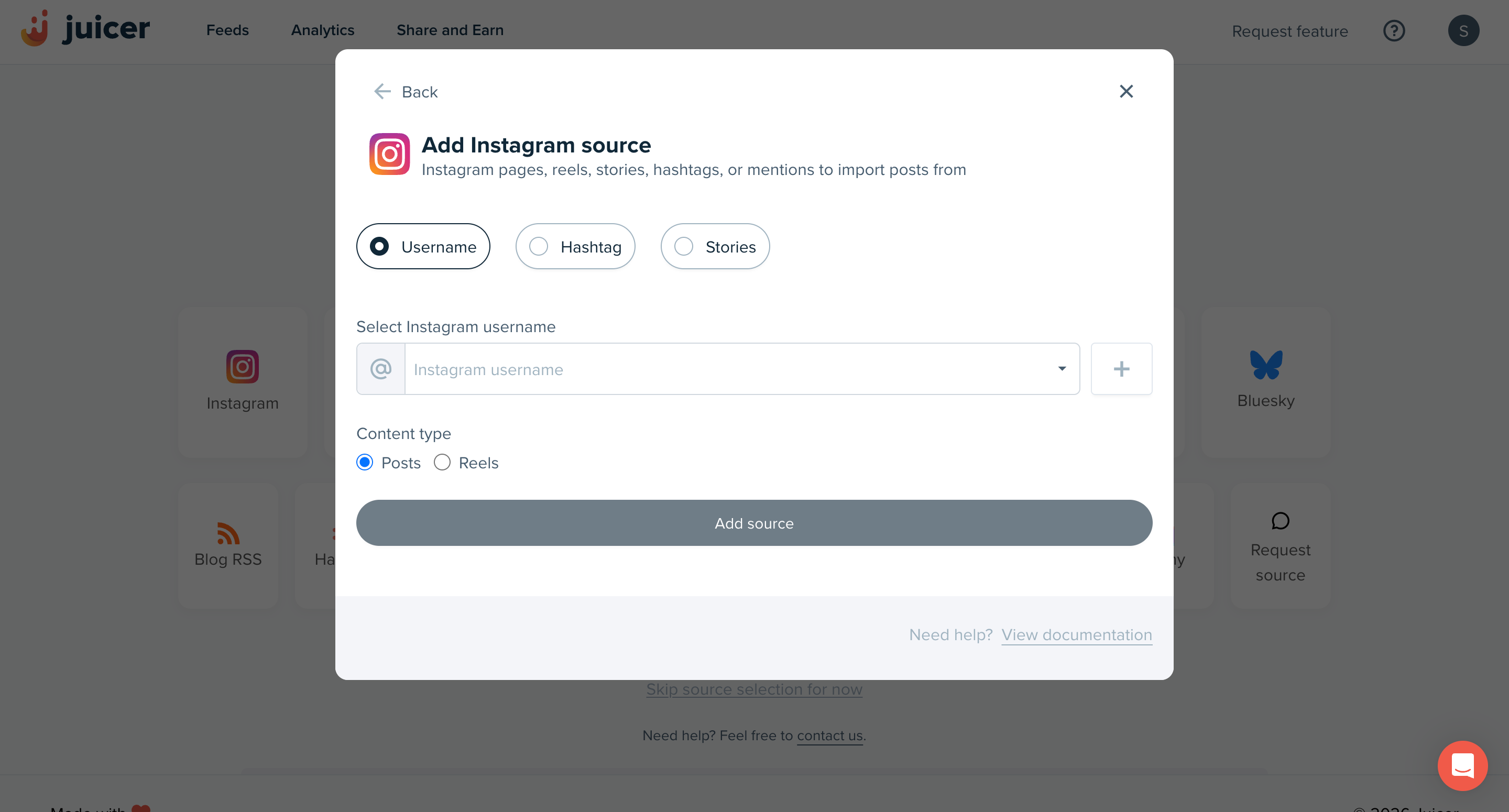
  1. Create a free account on Juicer.io – the trusted choice of 200,000 users worldwide. Once you’re in, select Instagram as the social media source.
  1. Choose whether you’d like to post your Instagram profile, a specific hashtag, or Instagram stories on your website.
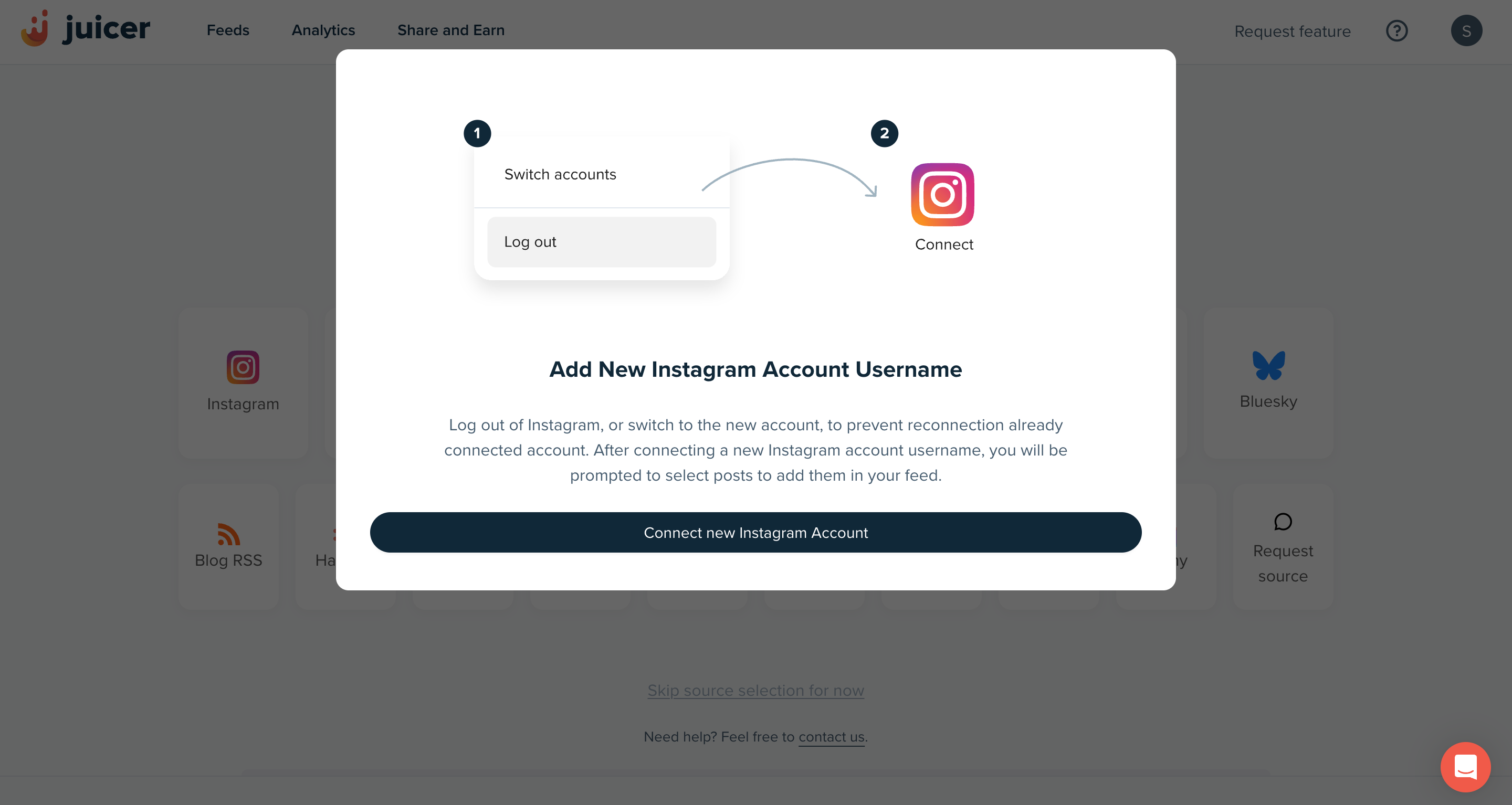
  1. Connect your Instagram account with Juicer to proceed further.
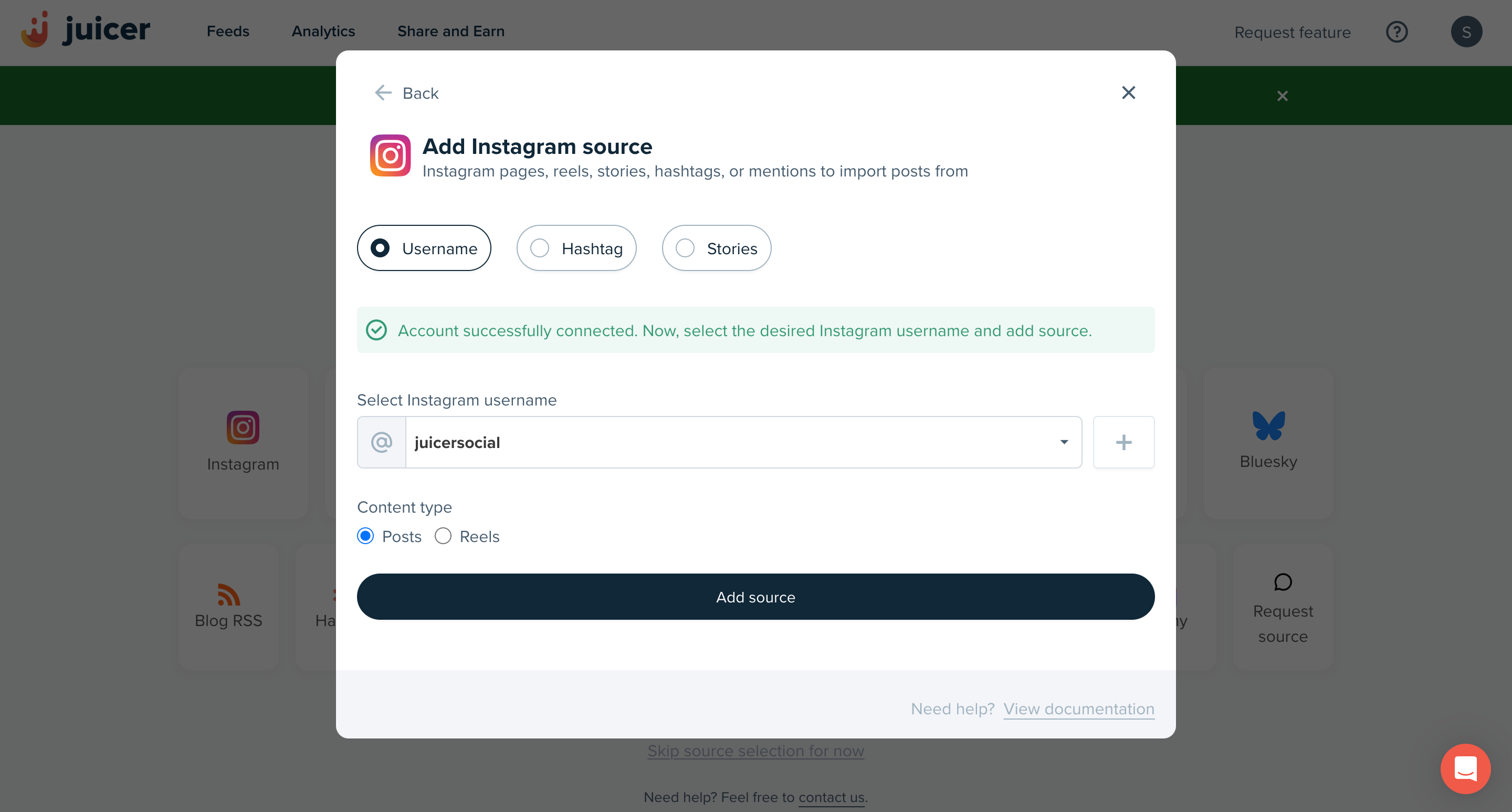
  1. Once connected, click on “Add source” to load your feed.
  1. Once your feed is loaded, click the “Embed” button in the top right to get the code for displaying the feed into your website.
  1. Select your embed method from Standard, iFrame, or WordPress, depending on how you plan to add the feed to your website. Click on “Copy code” if you’re embedding the feed yourself or click on “Send to developer” if your team member will be taking over.
  1. Add the embed code to your chosen web page to successfully display the Instagram feed on your website.

Embed your Instagram social feed with Juicer.io

There is no denying that Instagram is a fantastic marketing tool, and by adding an Instagram feed to your website, you can truly maximize your efforts and easily provide social proof to users. Juicer’s Instagram feed is free to start and offers affordable options jam-packed with cool features. So what are you waiting for? Add an Instagram feed to your website today!

FAQs about embedding Instagram feed on website

Why embed an Instagram feed on your website?

Embedding an Instagram feed on your website keeps your content fresh without relying on developers or CMS updates. It lets marketing teams publish updates through Instagram, showcase shorter content that doesn’t need a full blog post, and give visitors a more dynamic, behind-the-scenes look at your brand – while encouraging them to follow you.

How do I embed an Instagram feed on WordPress?

To embed a Instagram feed on WordPress you can either use Juicer’s WordPress Plugin or use this guide that covers various methods on how to embed Instagram onto your WordPress website.

How do I embed an Instagram feed on WebFlow?

To embed an Instagram business account on WebFlow you can either use Instagram’s native embed code (limited) or you can use a social aggregator tool like Juicer.io, which allows for additional features like moderation and custom feeds. For more information you can refer to this guide that covers various methods on how to embed Instagram onto your WebFlow website.

What other social media platforms does Juicer.io support?

Juicer Social can help you embed social media feeds for LinkedInX – TwitterFacebook, and TikTok too.

Is my embedded Instagram feed mobile responsive?

Yes, your Juicer Instagram feed is designed to be responsive. It automatically adjusts to fit different screen sizes, ensuring a seamless user experience on both desktops and mobile devices. If you need more changes, you can add custom CSS media queries. This will help you adjust the display for your design needs.

Can I customize the appearance of my Instagram feed?

Absolutely! Juicer.io offers a variety of customization options. You can modify the feed’s layout, colors, typography, and spacing to match your website’s brand identity. Developers can implement additional customizations via custom CSS or by using Juicer’s configuration settings.

Can I moderate or filter the content that appears in my feed?

Yes, moderation tools are available to help manage the content displayed in your feed. You can filter out specific hashtags, keywords, or accounts that do not align with your brand. This ensures that you showcase only the most relevant and appropriate content on your website.