

On June 29, 2026, Juicer officially launched the Juicer API, a unified social media aggregator API designed to streamline multi-platform data fetching into a single integration pipeline. Developers, marketing agencies, and platform software partners can now seamlessly pull live social posts, user profiles, and public brand mentions from 15+ social networks through a single, normalized social media data API REST endpoint.
Beyond traditional software development, teams can instantly wire these identical social data streams directly into autonomous AI workflows. By deploying a built-in social media MCP server, Juicer normalizes raw data feeds from Instagram, TikTok, Facebook, X, YouTube, LinkedIn, and Reddit into a single unified schema that AI agents can interact with out of the box.
What we shipped, in one demo
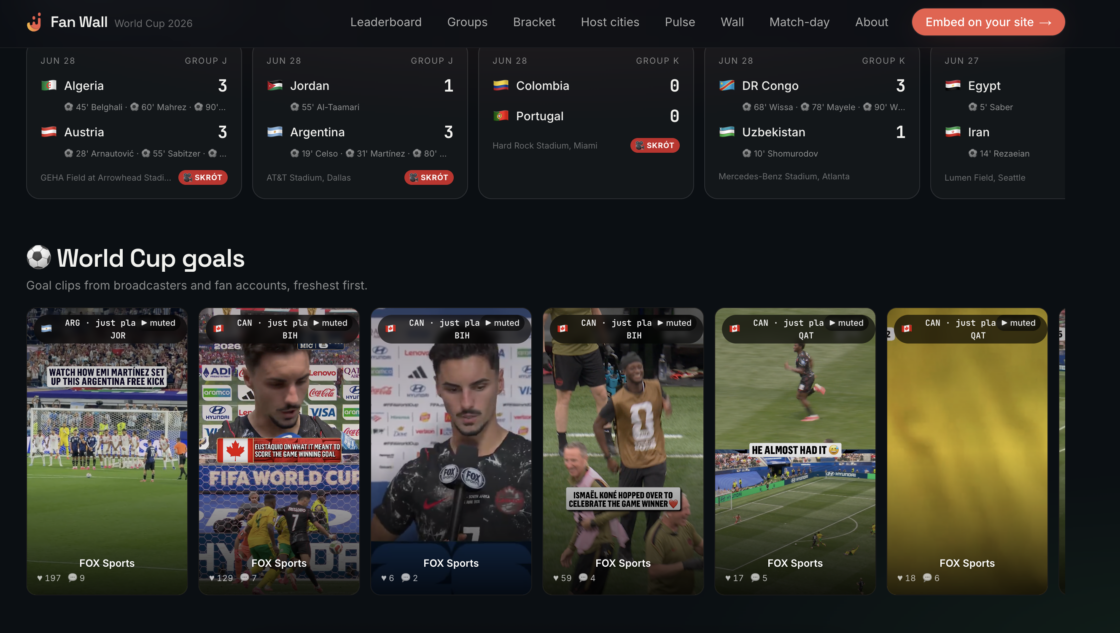
We built worldcup.juicer.io on this exact API.
It pulls live posts for all 48 World Cup 2026 nations.
It runs 65 feeds across Instagram and TikTok.
One non-technical person built the whole thing.
The Juicer API is not a side demo. It is the same engine that runs Juicer in production.
The problem with building social integrations yourself
Every social network ships its own auth, its own rate limits and its own response schema. They change without warning, so the integration you shipped last quarter breaks this week.
That leaves two bad options. You build and maintain fifteen separate integrations yourself, then spend every Monday patching the ones that broke. Or you stitch together point tools that each cover one network and never share a data shape.
How the Juicer Social Media Data API Simplifies Integrations
The Juicer API gives you the Juicer engine through three surfaces.
1. One normalized data API
GET /v1/data/posts returns posts with engagement. GET /v1/data/profiles returns follower and view stats. GET /v1/search/posts filters by term and platform. Likes, comments, shares and views come back the same way whether the post started on Instagram, TikTok or YouTube. You authenticate once with a single Api key.
2. Feeds and sources you can script
POST /v1/feeds spins up a feed. POST /v1/feeds/{id}/sources adds an account or a hashtag. The feeds you create through the API are the same feeds Juicer renders, so you can build, populate and embed without opening the dashboard.
3. An MCP server for AI agents
POST api.juicer.io/mcp exposes 34 tools over the Model Context Protocol, secured with OAuth 2.1. Connect Claude, Cursor or ChatGPT, then describe what you want. The agent creates the feed, connects the sources and moderates the posts on its own.
How to start
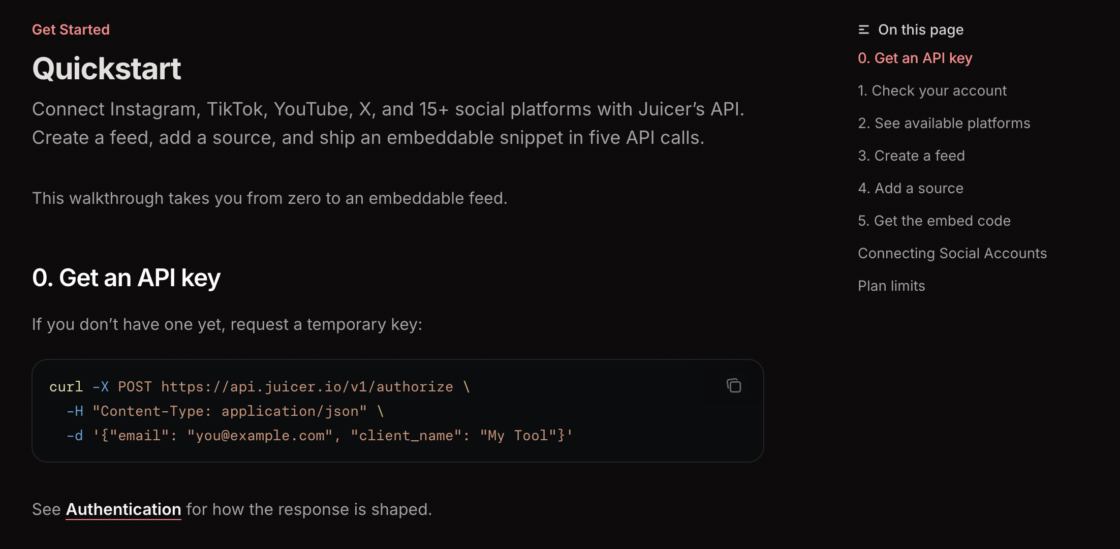
- Grab a free Sandbox key at juicer.io/api.
- Copy the snippet for cURL, Node, Python or Ruby.
- Make your first call to
/v1/data/posts. - Connect the MCP server by adding one block to your client config.
- Ship.
Real use cases
Agencies: Build a brand-listening dashboard for every client and bring their feeds to life in seconds, with no per-network engineering.
SaaS and platform partners: Embed live social feeds inside your own product and let your users connect their accounts through Juicer.
Developers: Ship a social wall, a hashtag campaign page or a mentions monitor on top of one API instead of seven.
Events and media: Run a live hub like the World Cup fan wall, 48 nations across Instagram and TikTok, updated by the minute.
AI builders: Give an agent the Juicer MCP server and let it create feeds, pull mentions and moderate posts from a single prompt.
Pricing
The Juicer API runs on a credit model. A free Sandbox key gives you 30 credits to test every endpoint. Paid tiers add production volume and higher limits. Credits are spent fetching fresh posts. Querying data you already pulled is free. See juicer.io/api for current tier pricing.
Juicer Social Media API FAQs
The Juicer social media API natively supports 15+ networks, including Instagram, TikTok, Facebook, X (formerly Twitter), YouTube, LinkedIn, and Reddit. Every platform queried through the engine returns the exact same normalized post and profile data shape, completely removing cross-platform data mapping issues.
No, the Juicer engine entirely manages background authentication, individual platform rate limits, and unexpected response schema changes on your behalf. When building integrations, you authenticate only once directly to Juicer using a single Api key.
The Juicer MCP server is a dedicated gateway located at api.juicer.io/mcp that exposes 34 specific platform actions directly to AI clients via OAuth 2.1. By connecting the Juicer MCP server, AI models like Claude, ChatGPT, or Cursor can autonomously generate feeds, aggregate mentions, and handle post moderation from a single text prompt without navigating a visual dashboard.
Usage on the Juicer API is calculated using a flexible credit model where tokens are spent strictly when fetching net-new, fresh posts from a social network. Reading or querying existing social data you have already pulled into your account is completely free, though the specific credit cost per fetch varies depending on the destination platform.
Yes, agencies and platform partners can freely build custom, client-facing brand-listening dashboards or embedded elements powered entirely by the Juicer API. For teams looking to scale, the dedicated Juicer Platform Partner tier is specifically optimized for white-labeling, reselling, and deep application embedding at enterprise volume.
Try it
Grab a free Sandbox key at juicer.io/api and make your first call in minutes. The docs at developers.juicer.io walk you through every endpoint.